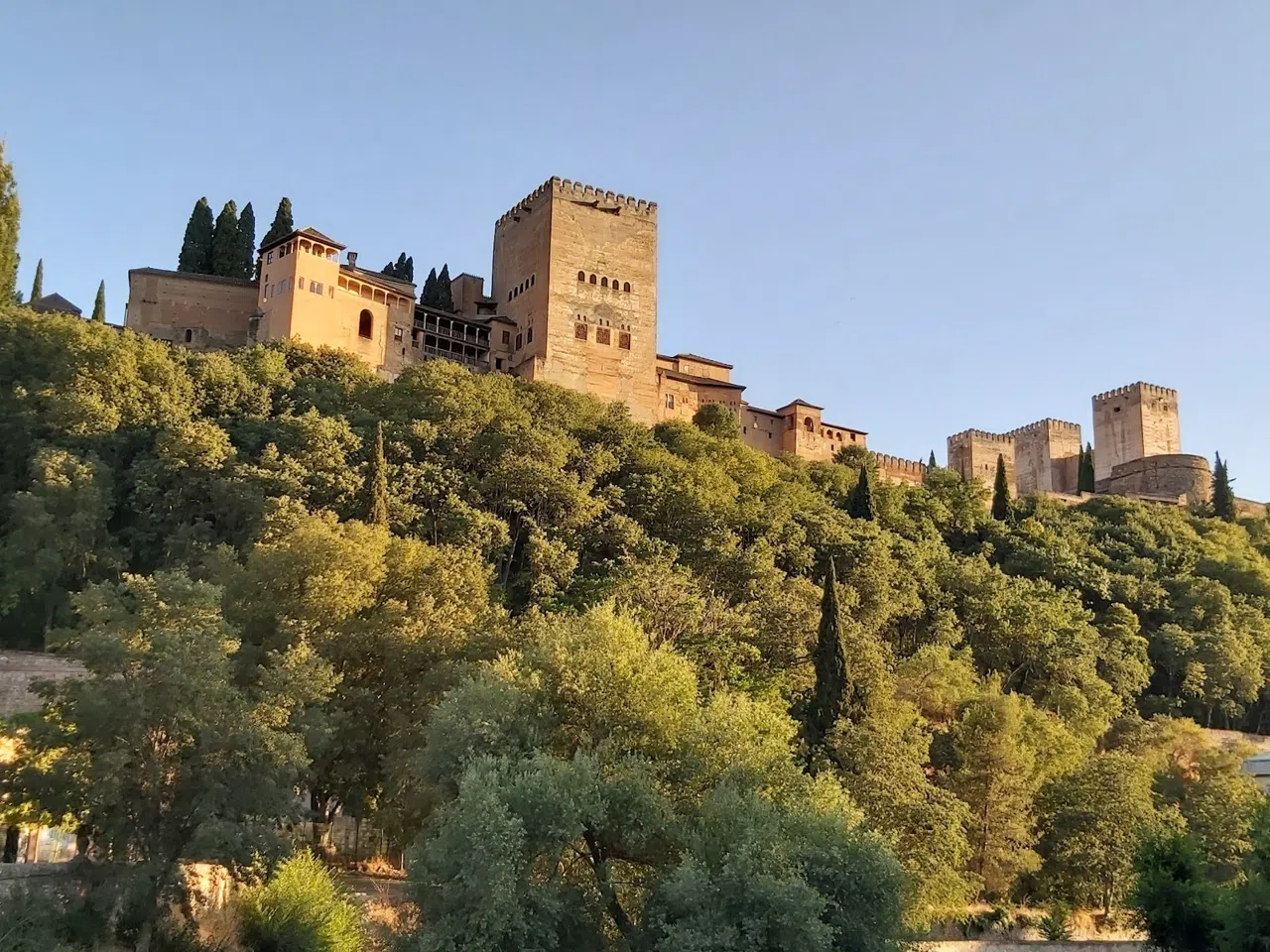
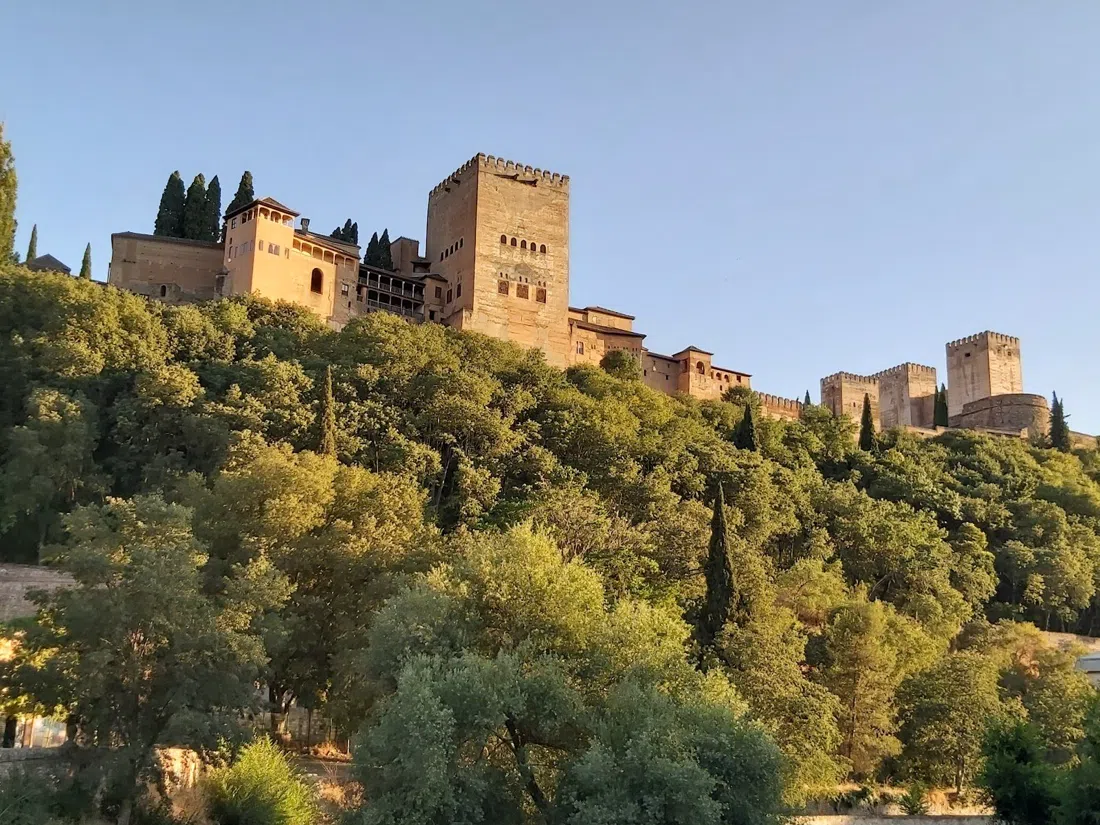
At half past six on the Cuesta del Chapiz the paving is still damp from a sweeper who has already gone home, and the loudest thing on the hill is water: the acequias running under the garden walls, doing the job they were dug for a thousand years ago. Uphill to the left the Albaicín is a grey mass of whitewash with its lamps still burning; across the river to the right the Alhambra sits in its own shadow, unlit, with nobody pointed at it. Then the sun clears the Sierra and for roughly forty minutes the two hills trade places. The fortress goes red while the Albaicín stays blue, then the Albaicín goes gold while the Alhambra flattens out into ordinary daylight. It is the finest thing to look at in this city, and the only one that costs nothing and needs no ticket.
Where the two hills part company
The walk has to start at Paseo de los Tristes (officially Paseo del Padre Manjón, the riverside promenade under the Albaicín), because this is the one place in Granada where the geography explains itself. Stand with the Darro on your right and the road forks in front of you: the Cuesta de los Chinos climbs to the Alhambra, and the Cuesta del Chapiz climbs to the Albaicín and on to Sacromonte. Two hills, one set of paving stones, a hundred metres of separation and about eight centuries of argument between them.
It is open street, with no door, no limit and no charge. By eleven in the morning it is a car park for walking groups and the terraces are full; at 06:30 you will have it entirely to yourselves, which is the only time you can hear how much water is moving under the city. Give yourself a full hour before sunrise if you want to reach the top in the dark, and check the day's actual sunrise before you set an alarm: it swings by well over an hour across the year in Granada, and the clocks move on the last Sunday of March and of October, which shifts it by another hour overnight. Wear proper shoes. The cuestas are cobbled, steep and slick with dew, and the gradient is not a joke. If you are still deciding where in the city to sleep so that this walk is possible on foot, our Granada guide covers how the districts sit relative to one another.
Going up in the dark
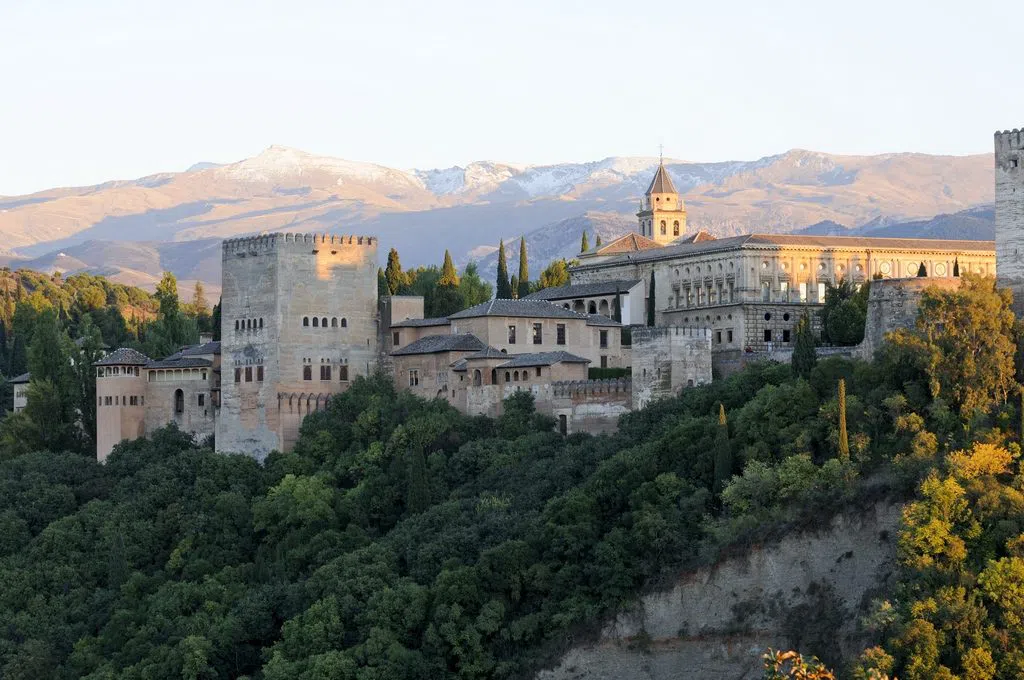
The climb that pays is the one to Mirador de San Miguel Alto (the ridge above the top of the Albaicín, beyond the old city wall). It is the highest point in Granada and the only vantage that puts both hills in one frame: the Albaicín spilling down to your left, Sacromonte's cave terraces to your right, the Alhambra and the snow line behind them. That single view is why you do this walk rather than any of the easier ones, and why the hour before sunrise is worth the alarm. You want to be sitting on the stones when the light lands, not still climbing.
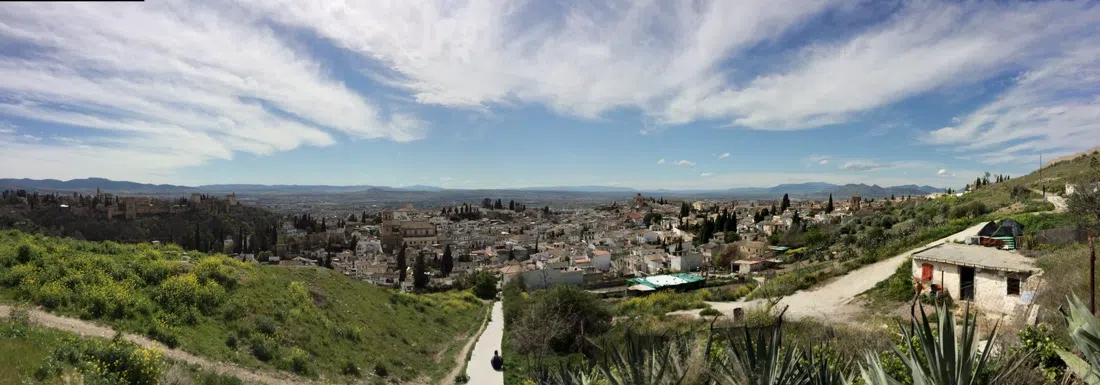
The last stretch deserves a straight warning. The final twenty minutes are a steep unlit dirt path, loose underfoot, with no handrail and no lighting whatsoever. Bring a torch each, because a phone screen is not enough, and do not attempt it alone if you are unsteady on rough ground. There is no gate and no closing time, which cuts both ways: the hilltop has its own late-night drinking crowd, mostly harmless and mostly leaving as you arrive, and you will pass the bottles they left behind. Nothing here is policed. Keep your bag closed and your phone in a pocket rather than a hand, and come down by the lit lanes rather than the dirt once the sun is up.
For a group this is easily the best stop of the morning, because the ground is open and there is room for twenty people without anyone jostling for the parapet. For anyone with mobility limits it is not viable at all, and there is a better answer further down this page.
The famous balcony without the crush
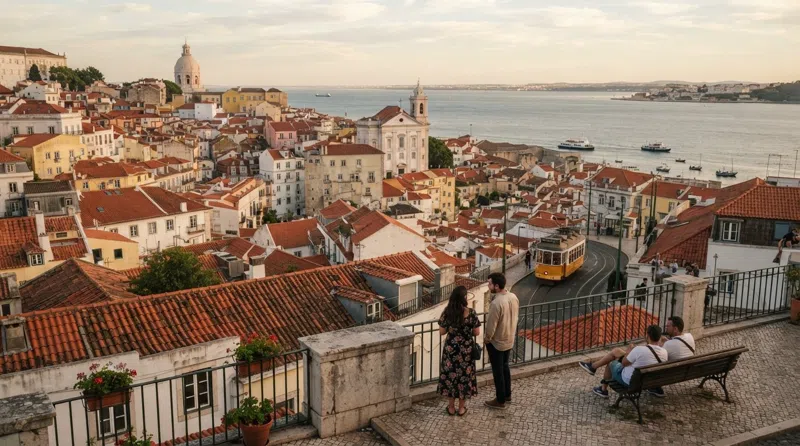
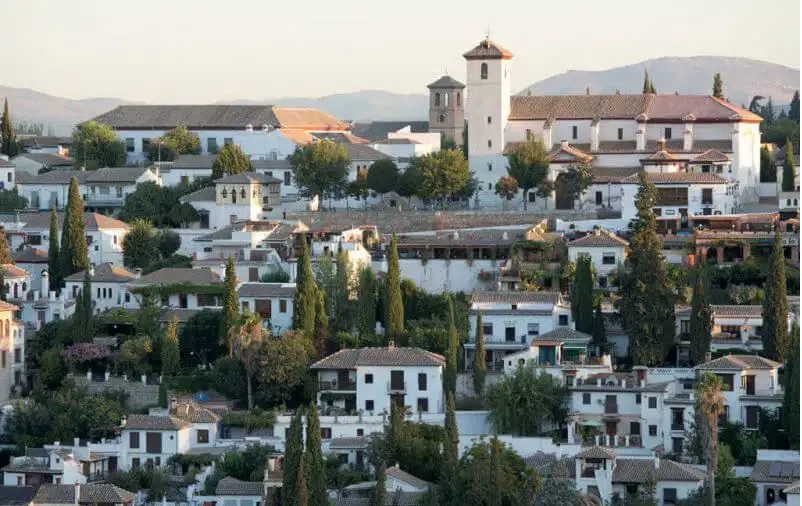
From San Miguel Alto the lanes drop about ten minutes to Mirador de San Nicolás (mid-Albaicín, beside the church of the same name), the viewpoint every photograph of Granada is taken from and, at the wrong hour, the least pleasant place in the city. At sunset it holds something like three hundred people, a rank of guitarists, hawkers working the wall and a queue for the parapet.
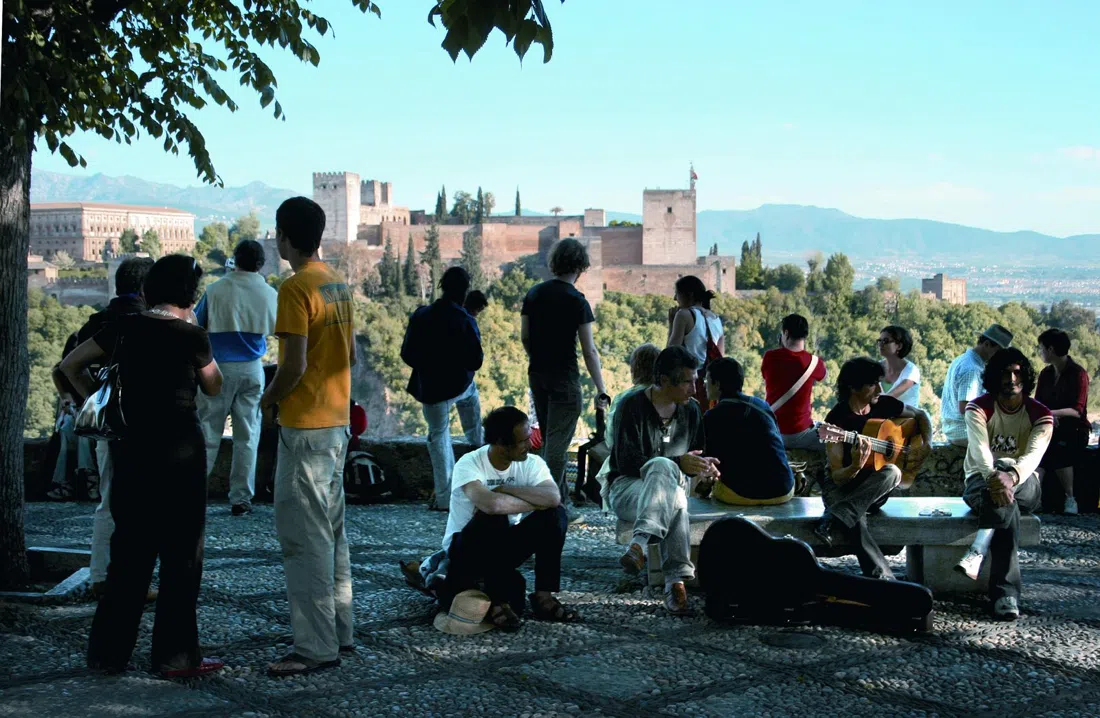
At seven in the morning it is empty, and the view is also better. At sunset you are looking into the sun and the Alhambra is backlit, a silhouette on a bright sky. At dawn the low sun comes from behind you and strikes the red walls head-on, so the whole complex glows rather than flattens, with the Sierra Nevada lit behind it. There is no ticket, no fence and no closing time. A large group fits with ease at this hour, which is never true after five in the afternoon.
Two smaller miradors that solve two problems
If you want the Alhambra close rather than wide, walk down to Mirador Placeta de Carvajales (lower Albaicín, a few minutes below San Nicolás through the lanes). From this balcony the palace stops being a skyline and becomes a building: you can pick out individual towers, the roof tiles, the line of the ramparts, near enough to shout at. Almost nobody knows it is there. It is also tiny. Ten people fill it completely, so this is a stop for couples and pairs, not for a party of twenty. If you arrive and find four people already at the rail, come back in twenty minutes.
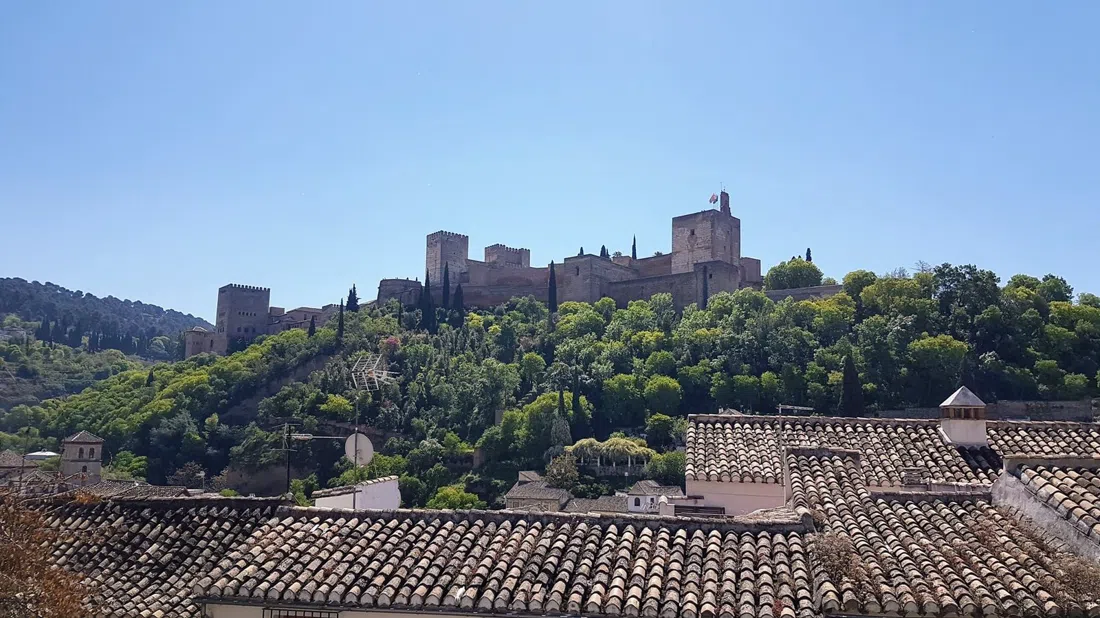
If someone in the group cannot manage cobbles and dirt, take them to Mirador de San Cristóbal (northern edge of the Albaicín, on the road out towards Murcia). It is roadside, open at all hours, free, and the only viewpoint on this walk a minibus or a taxi can actually pull up at. The postcard is somewhere else; what this one gives you is the wall. From here the surviving Zirid ramparts run down the hillside, and in one glance you understand that the Albaicín was a fortified town long before it was a picturesque one. Take the people who need wheels here, let everyone else climb, and meet for breakfast.
Breakfast at the hour the Albaicín starts
By now it is somewhere around eight and you want coffee. Bar Aixa (Plaza Larga, in the upper Albaicín) opens between six and seven, which is the entire point of it: this is where the district's own morning begins, with builders, bus drivers and people walking dogs, and you can be at the counter before the first minibus runs. Breakfast is €2–4 for coffee and toast with tomato and olive oil, and a full sit-down meal later in the day runs €10–20. The terrace on the plaza is where you want to be once the sun is on it.

It is closed on Tuesdays, so build the whole dawn walk around that if you want a hot drink at the end of it rather than a vending machine. A small group at the bar is fine, but anything over about six should call ahead and take the restaurant side rather than turning up and colonising the terrace.
What opens at ten
Nothing with a door is open during the dawn hour, which is why the walk runs uninterrupted and the interiors come afterwards as the reward rather than the itinerary.
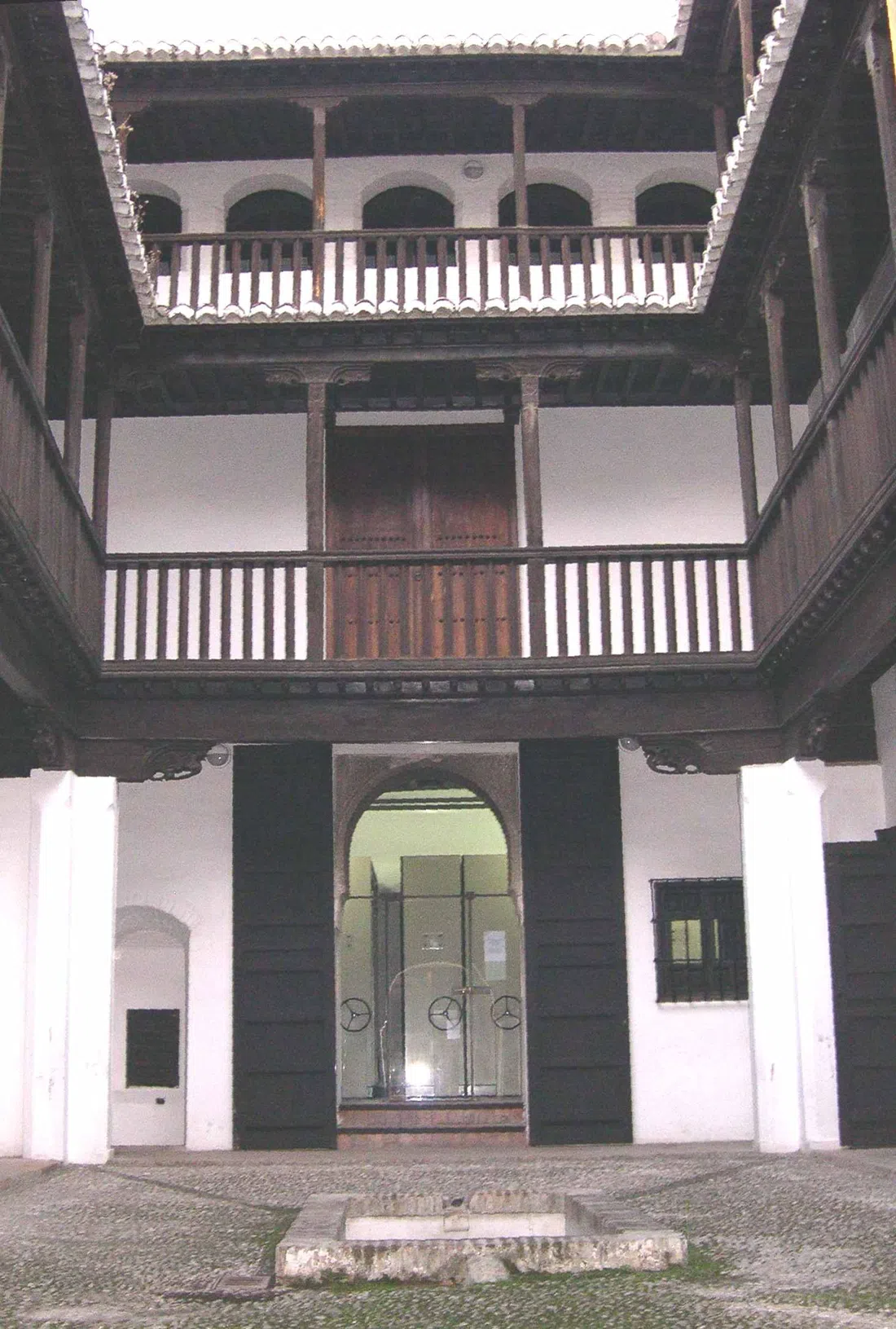
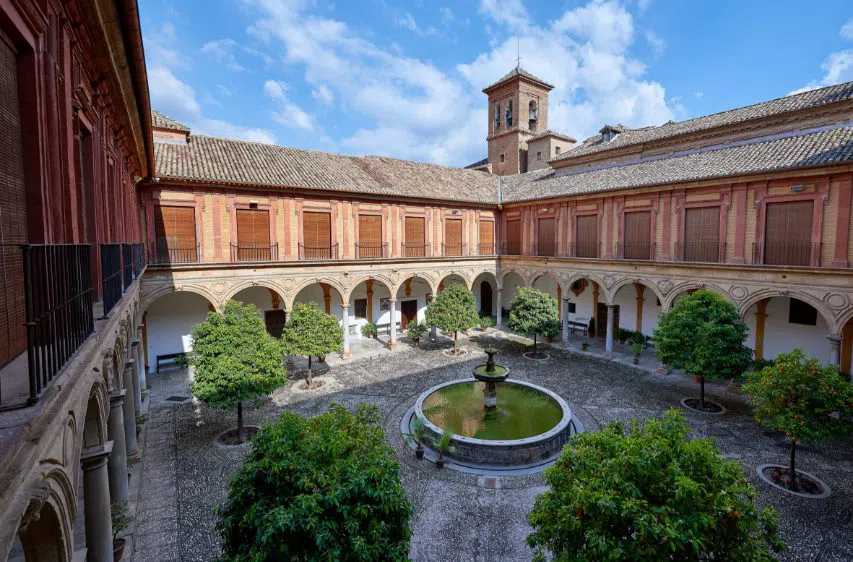
The first one to hit is Casa del Chapiz (on the Cuesta del Chapiz itself, at the point where the Sacromonte road peels off). It is a pair of joined Nasrid houses with a courtyard, a pool and a terraced garden, and it holds what is, to my eye, the single best framed view of the Alhambra anywhere on this hill: the palace sitting in an arch of cypress with the water in front of it. Entry is free. It is also a working research institute, the Escuela de Estudios Árabes of the CSIC, which sets the etiquette. The building is small, so a group should split and go in in waves, and coach parties are unwelcome inside a school where people are trying to work. Doors open at 10:00, or 09:00 in high summer.
Down the Sacromonte road, Museo Cuevas del Sacromonte (Barranco de los Negros, Sacromonte) opens at 10:00 and gives the honest account of who actually lived in these caves: Roma families, day labourers, the flood of 1963 that emptied half the hill. It is not the account you will get from the flamenco caves lower down. It is €5 for an individual, and unusually well set up for groups: €4 per person self-guided for ten or more, €6 per person guided, and €50 for a family or private guided visit with a further €50 if you want it in English. No advance booking is needed.

Keep going and the road ends at Abadía del Sacromonte (the top of the Sacromonte road), the abbey and catacombs that gave the hill its name and the site of the seventeenth-century relics that are still the strangest chapter in Granada's history. You cannot wander in: the guided visit is compulsory and runs in fixed slots, €7 general with concessions, and advance booking is strongly advised, with group discounts if you ask. Book it, and treat it as your 10:00 finish.
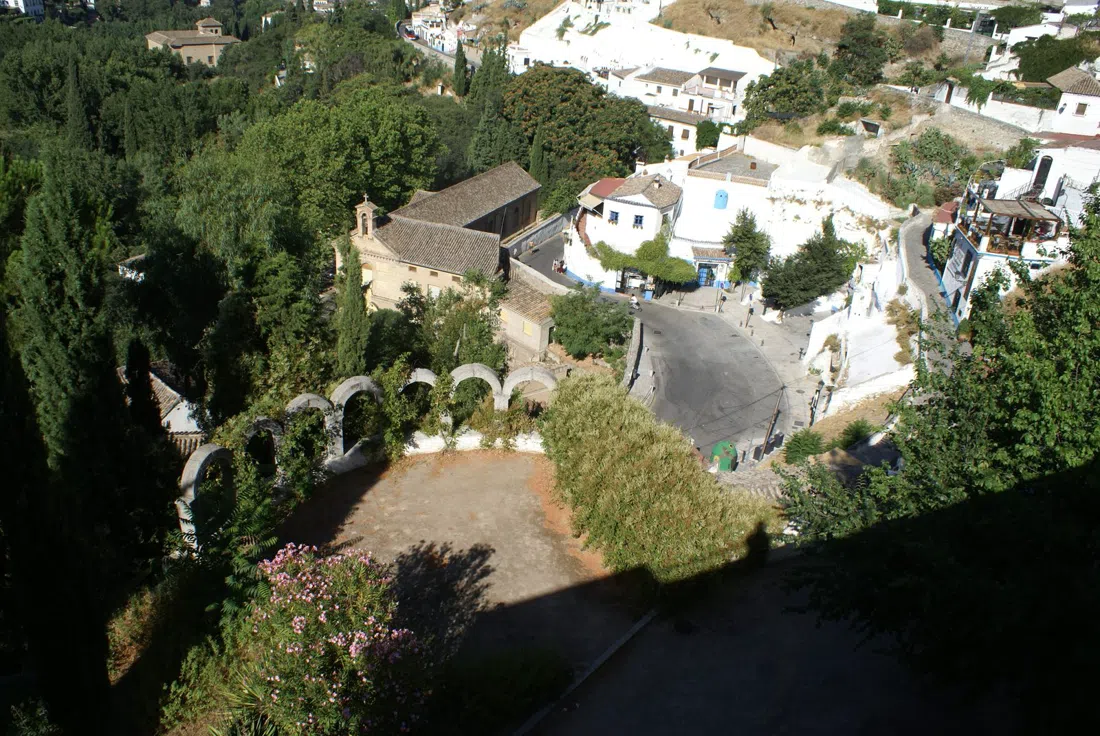
On the way back, Auditorio Municipal Enrique Morente – La Chumbera (Sacromonte, on the hillside facing the Albaicín) is the counterweight to San Nicolás: free public terraces in daylight, looking straight across at the whitewashed slope you spent the morning walking down. Its scenic roof was rebuilt in August 2026 and the auditorium is properly live again. The Patrimonio Flamenco season runs 13 October to 22 December 2026, with concerts roughly €10–25 and group bookings through the city box office. The terrace costs nothing; the hall needs a ticket and only opens for shows.
The cistern under the whitewash
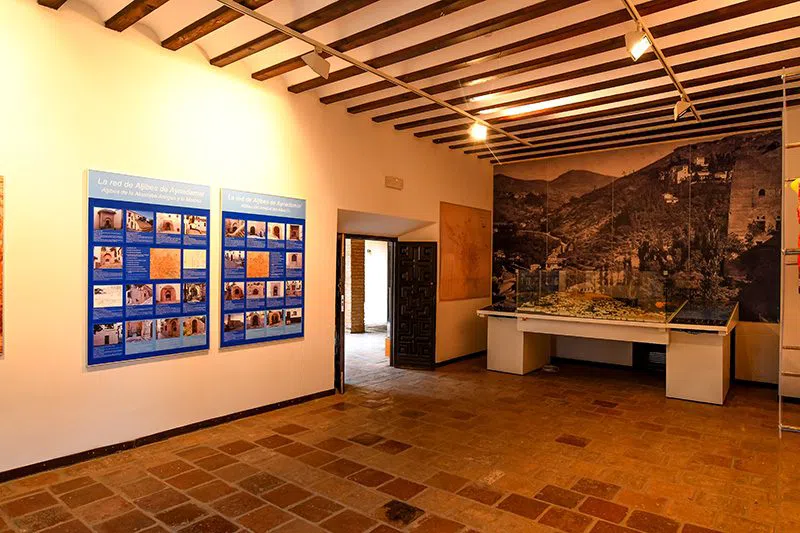
If you have an afternoon spare, Carmen del Aljibe del Rey – Centro de Interpretación del Agua (Placeta del Cristo de las Azucenas, Albaicín) closes the loop on everything you heard running under the walls at dawn. It is the largest Muslim cistern in Granada, 300 cubic metres of it, and the reason this hill has a fountain on nearly every corner. Entry is free, free guided visits run on weekdays at 12:00 with no reservation, and the place is built for groups, with a maximum of thirty per group and occasionally two at once if the guides allow it. Larger parties can book directly with the foundation.
Walking it as a group, or with a guide
If you want this hour guided, there is one realistic route to it. Every scheduled Albaicín and Sacromonte walk in Granada, the free ones included, departs in the afternoon or at sunset, because that is when the paying volume is. So the dawn version has to be privately arranged, and Cicerone Granada (a licensed guiding company based in the centre) is the one that does it. Private groups are their whole model, prices start from around €160 per group for about two hours, and they state plainly that schedules are adjustable. Email or phone them and ask for a pre-sunrise start. Split across four or six people that is not extravagant, and a licensed guide is the difference between looking at a wall and knowing which century built it.
Practical notes
Walk up, ride down. The little C-line minibuses that loop the Albaicín and Sacromonte from Plaza Nueva are the only motor traffic that fits these lanes, but the first departures come well after the hour you want, so the climb is on foot by definition. Taxis will take you to Mirador de San Cristóbal and along the Sacromonte road, not into the upper lanes.
Carry a torch each for the San Miguel Alto path, water, and a layer more than you think you need. Granada sits high with the Sierra Nevada at its back, and even in July the pre-dawn air on that ridge is genuinely cold. Bags closed, phones pocketed.
Card works in most places, but the small bars and the odd ticket desk are happier with coins and small notes. Carry €20 in cash and you will not be caught out.
Aim to be at Paseo de los Tristes about an hour before sunrise, at San Miguel Alto fifteen minutes before it, at San Nicolás as the walls turn, at Bar Aixa by eight, and at a 10:00 door after that. That is a four-hour morning, most of it downhill after the first climb.
The entire dawn portion is free. Breakfast €2–4, the cave museum €5, the abbey €7: under €20 a head for the whole morning, or from €160 for a private group with a guide. For somewhere to stay within walking distance of the bottom of the cuesta, start with our Granada hotel search; anything in the lower Albaicín or around Plaza Nueva puts you at the fork in ten minutes, which matters a great deal at six in the morning.